
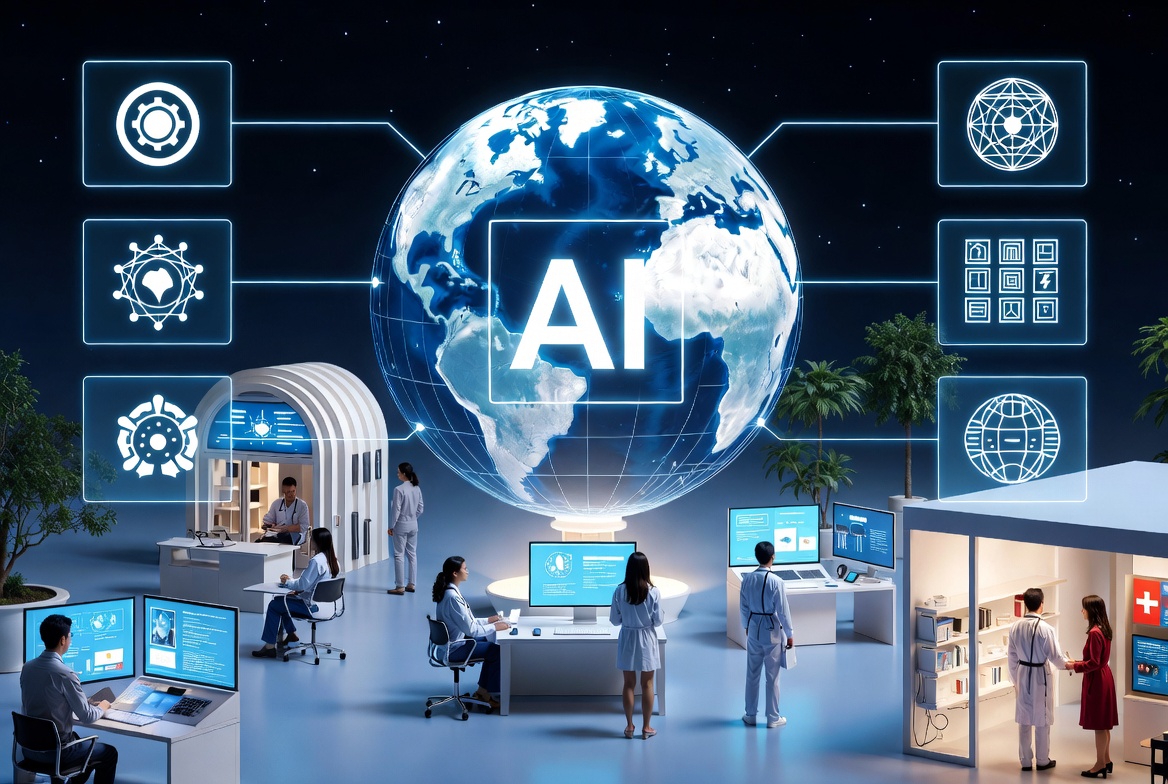
A group of Chinese scientists and researchers from leading research institutes have presented a long-term forecast "Tech Predictions and Future Visions 2049,” which looks at how technology and society could develop by the middle of the 21st century. The vision covers ten key areas, including artificial intelligence, robotics, computing, energy, healthcare, transportation, and space exploration.
Unlike many discussions that often view advanced technologies through the prism of risk and loss of control, the report takes a more optimistic and development-oriented approach. Artificial intelligence, and even the idea of superintelligent systems, is not primarily described as a threat, but as a potential opportunity, provided that its development and application are guided by clear rules, ethical frameworks, and social agreement.
The authors assume that AI will be strongly integrated into everyday life, from industry and healthcare to the management of complex systems. Instead of apocalyptic scenarios, the emphasis is on how to shape and direct technology, not just how to develop it.
Education in the Age of Artificial Intelligence
The vision of education for the future is particularly interesting. It is predicted that the traditional model of education, limited to certain life stages and unique curricula, will gradually give way to personalized and lifelong learning.
Artificial intelligence will enable educational systems that adapt to the individual: their interests, abilities and learning pace. Instead of emphasizing information memorization and standardized exams, the focus will be on the development of critical thinking, creativity, problem solving and the ability to learn throughout life.
In such a system, formal diplomas and certificates lose some of their importance, while the continuous acquisition of new knowledge and skills becomes crucial, especially in a world where technologies and professions are changing rapidly.
The BrAIn project: thoughtful application of AI in education
While scientific reports offer long-term projections, the BrAIn project (Application of digital technologies based on artificial intelligence in education) is already laying the foundations for a responsible attitude towards artificial intelligence in the Croatian school system, addressing the questions of how, why and under what conditions AI has a place in education.
The project does not assume that artificial intelligence is a necessary solution, but rather the need to understand, critically examine and, if necessary, limit its use. The activities are aimed at ensuring that teachers (become) experts who decide on the use of technology in teaching, rather than its passive users.
The project focuses on several related areas:
- Curriculum development – curricula on artificial intelligence have been developed for primary and secondary schools in order to introduce these topics in a systematic, thoughtful and pedagogically based manner.
- Education of educational staff – teachers are empowered to understand artificial intelligence, its pedagogical application and critical evaluation, while maintaining professional autonomy in the choice of methods and tools.
- Personalisation of learning – the application of smart learning support systems that can contribute to the adaptation of teaching to individual students is being explored, with a clear distinction between pedagogically guided personalisation and automated (algorithmic) recommendations without expert judgement.
- Research and guidelines – scientific research is conducted on the impact of artificial intelligence on education and recommendations are made for the ethical, safe and responsible use of technology in schools, while considering the social and pedagogical consequences.
In this way, artificial intelligence is not promoted as an end in itself, but as a topic for teaching and reflection. This already creates a framework for informed decisions in education today and strengthens the role of teachers as bearers of pedagogical judgment in the digital environment.
Conclusion
The technological future is not predetermined, but depends on the decisions made today. Artificial intelligence in education opens up new possibilities, but also requires reflection on its purpose, limits and consequences, which the BrAIn project seeks to observe in a pedagogical and social context.