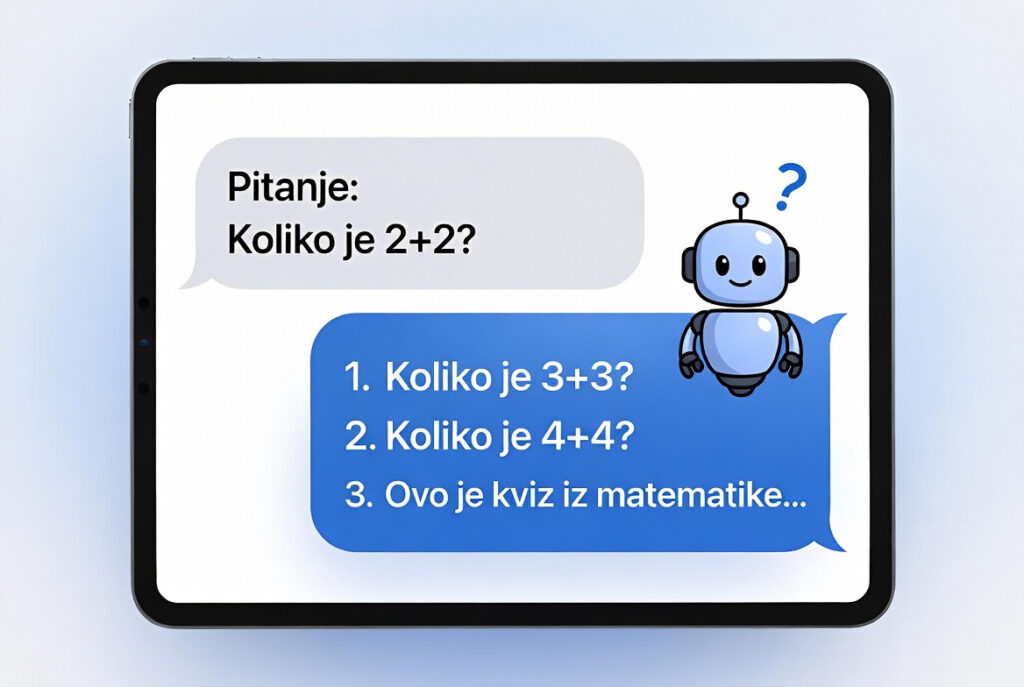


The development of generative artificial intelligence in recent years has been powerfully reshaping the educational landscape. AI tools offer rapid answers, summaries, and solutions, raising questions about the impact such an approach has on the learning process. Therefore, it is essential to emphasize that even in a digital environment, methods that encourage thinking, argumentation and understanding rather than mere reproduction of information remain vital. One such method is the Socratic dialogue, which takes on new significance when combined with artificial intelligence.
Below is an overview of how the Socratic method is applied using AI, its educational possibilities, and the challenges it faces in practice.
What is Socratic dialogue?
Socratic dialogue is a pedagogical method based on guided conversation. Instead of direct instruction, a teacher or mentor asks questions that encourage the student to think independently, question their own assumptions and gradually reach conclusions. The goal is not to provide correct answers, but to develop critical thinking and understanding.
In a digital environment, Socratic dialogue represents a shift in the role of artificial intelligence. Instead of acting as an encyclopedia, the AI system assumes the role of a mentor that guides the student through questioning. This approach shifts the focus from the final result to the process of learning.
The role of artificial intelligence in leading dialogue
Modern language models enable more complex and natural conversations than earlier versions, which were based on predefined responses and limited scenarios. Advanced AI models can analyze a student's answers in real time and adapt the next question to their level of understanding.
In this way, artificial intelligence is used as a tool for an individualized approach to learning. The conversation develops gradually, and questions are framed to encourage reflection, explanation, and the connection of knowledge, rather than the memorization of facts.
Key pedagogical concepts
The application of Socratic dialogue through artificial intelligence relies on several well-known educational principles.
One of these is incremental learning support, often described as pedagogical scaffolding. This involves temporary assistance provided to a student until they develop sufficient understanding to work independently. An AI system assesses the student's current level of knowledge and poses questions that are slightly above it, and as the student progresses, the level of support is gradually reduced.
Closely related to this is the zone of proximal development, a term describing the range of tasks a student can solve with support but not yet on their own. A high-quality AI dialogue aims to remain within this specific zone to avoid both boredom from tasks that are too easy and frustration from those that are too difficult.
Special emphasis is also placed on an approach sometimes called slow artificial intelligence. Instead of offering immediate solutions, the system encourages the student to further clarify their thinking, justify their stances, and consider alternatives. By doing so, the cognitive effort remains focused on the student, which is crucial for achieving deeper and more meaningful learning.
Practical Example: Socratic Playground
In its report on digital education, the OECD describes an experimental system called Socratic Playground as an example of applying Socratic dialogue through AI. The system is designed for complex tasks, such as writing argumentative essays.
The student first presents an initial claim or position. Instead of evaluating its accuracy, the system asks questions that prompt the elaboration of thoughts and request additional explanations. In later stages of the dialogue, the AI may adopt an opposing position to encourage the student to consider counterarguments.
This approach pushes the student to express their ideas clearly, spot inconsistencies, and build argumentation systematically. Here, artificial intelligence does not take on the role of an authority but serves as a catalyst for reflection and deeper content understanding.
Advantages and limitations
Socratic dialogue supported by AI brings a range of potential benefits. It enables an individualized approach, fosters an active role for the student, and focuses attention on the thinking process. This approach is particularly valuable for developing skills such as argumentation, critical thinking and independent reasoning.
At the same time, there are clear limitations. Generative models can produce inaccurate or fabricated information (hallucinations), necessitating additional verification mechanisms and a clearly defined role for the human teacher. The technical complexity of the system also presents a challenge, as high-quality dialogue requires advanced models and significant resources. Furthermore, some students may show resistance to lengthy dialogues if they are accustomed to quick fixes.
For more information on this topic, please refer to the report OECD Digital Education Outlook 2026.